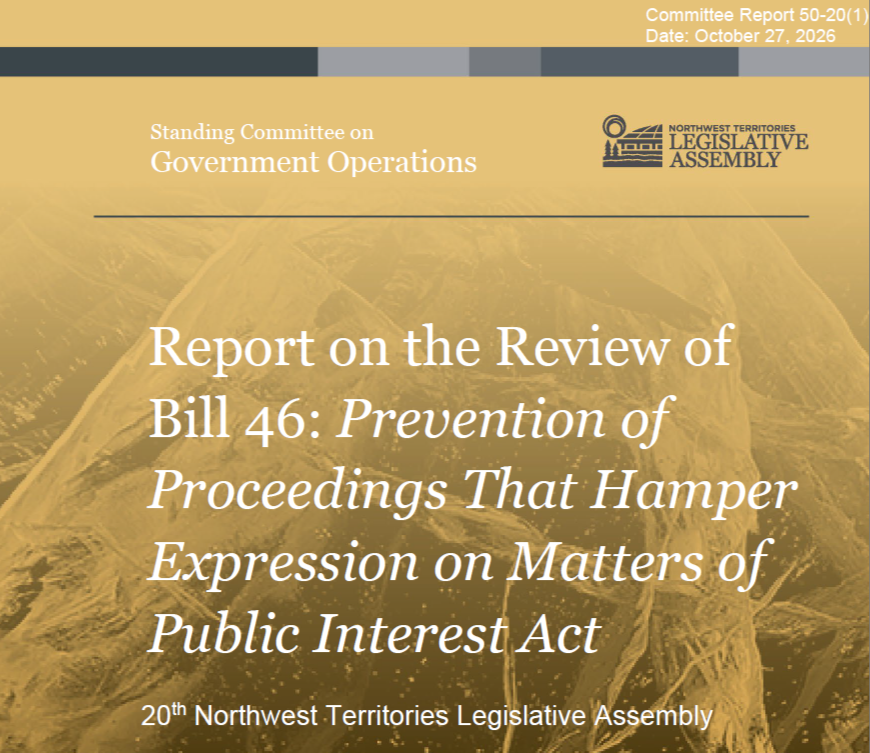
The Northwest Territories has passed its first law to protect public speech from lawsuits designed to silence it. Here is what the law does, why it matters to you, and what Alternatives North contributed.
The Legislative Assembly of the Northwest Territories has passed third reading of Bill 46, the Prevention of Proceedings That Hamper Expression on Matters of Public Interest Act, as reported by Cabin Radio and the Yellowknifer. Once it receives assent, the NWT will have an “anti-SLAPP” law: a legal tool that lets a judge dismiss, early and at the plaintiff’s expense, a lawsuit whose real purpose is to silence someone speaking out on a public issue.
Alternatives North made a detailed submission to the Legislative Assembly’s Standing Committee on Government Operations in June 2026. Most of what we asked for is now in the law. This post explains what a SLAPP is, why this matters to ordinary residents, how the bill got here, and what happened to each of our recommendations.
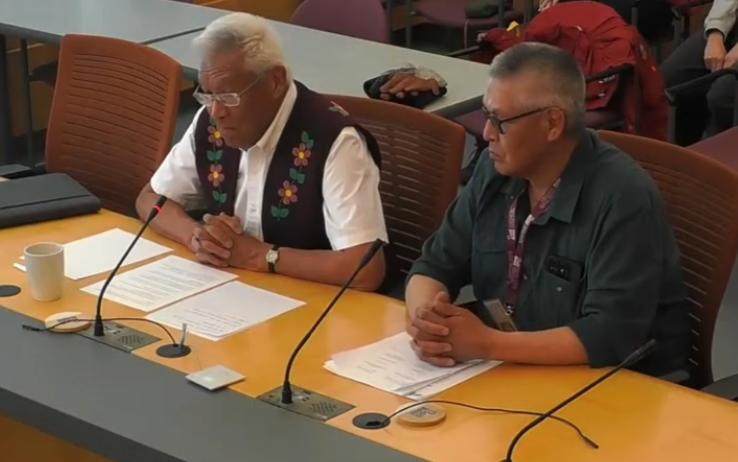
Alternatives North commends Mackenzie Delta MLA George Nerysoo and his constituent Lawrence Norbert for their work on this important legislation to protect NWT residents and their rights to express themselves and organize without intimidation.
Kevin O’Reilly, Alternatives North
Why this matters to you
A SLAPP, or strategic lawsuit against public participation, is a lawsuit brought to censor, intimidate or silence critics by burdening them with the cost and stress of a legal fight. The plaintiff does not need to win. Often the point is that the person being sued cannot afford to keep going, and that everyone else watching decides it is safer to stay quiet.
That is not just a problem for activists and reporters. It can reach anyone who speaks up about something that affects their community: a resident who questions a development at a public meeting, a member of a community group who criticizes an organization or its leaders, a freelance journalist, a person who posts about a public issue online. Anyone can be sued. Few people can easily pay a lawyer to defend themselves.
Several people and organizations told the Committee why this is especially important in the North:
- Silence has a history here. Gwichya Gwich’in Elder Lawrence Norbert, who brought the issue forward, described how students at residential schools were punished for asking “why?” and learned to keep quiet. The Committee heard that this legacy still shapes some communities, and the NWT Association of Communities told the Committee that removing the threat of consequences for speaking out matters to Indigenous Northerners with that experience.
- People with little money are most exposed. The Committee heard that the prospect of costly litigation can discourage residents from questioning governments, organizations or community leaders, and the NWT Ombud pointed out that SLAPPs fall hardest on individuals and advocates who lack the means to defend themselves.
- Public decisions need public debate. Community governments make most of their decisions in public. The NWT Association of Communities said a safe context for good-faith engagement, particularly in planning and development processes, fits the principle of open public discourse.
- A free press depends on it. The Canadian Association of Journalists warned that even the threat of a lawsuit can chill reporting, and that small and independent media and freelancers face the greatest risk.
We are finally finding our voices: we cannot allow lawsuits to take them away!
Lawrence Norbert, Gwichya Gwich’in Elder, submission to the Standing Committee on Government Operations, April 28, 2026
What the new law does
- Early dismissal. A person sued over expression on a matter of public interest can ask a judge to dismiss the case. They only have to show that the lawsuit arises from their expression and that it relates to a matter of public interest.
- The burden then shifts. The case continues only if the plaintiff shows it has substantial merit, that the defendant has no valid defence, and that the harm is serious enough to outweigh the public interest in protecting the expression.
- A pause. While the application is pending, the lawsuit stops. The Committee added a matching pause for related tribunal proceedings.
- Costs and damages. A defendant who wins dismissal is presumptively entitled to costs on a full indemnity basis, meaning their reasonable legal costs. A judge can also award damages if the lawsuit was brought in bad faith or for an improper purpose.
- Fast appeals. Appeals of these orders go directly to the Court of Appeal, without needing permission, and must be heard as soon as practicable.
- Clearer protection for what people say to each other. A consequential change to the Defamation Act confirms that qualified privilege for communications on a matter of public interest between people with a direct interest in it applies whether or not the media or others are present.
What it does not do
The Act does not give anyone a licence to say anything. The bill was written so that deliberately false, malicious or hateful speech is not protected, and a lawsuit that has substantial merit and addresses serious harm can still go ahead. Judges keep discretion over costs. The Act applies only to lawsuits filed after it takes effect. And it does not pay for a lawyer: Mr. Norbert asked the Committee for legal aid support, and the Minister of Justice noted that legal aid outreach lawyers are limited in their ability to represent people in court. This post is general information, not legal advice.
Why Alternatives North made a submission
Alternatives North is a social justice coalition working on social, environmental and economic justice in the NWT. That work means asking hard questions about public policy, resource development, public services and government decisions, in public. It only works if residents, including Elders and people with few resources, can take part without worrying that a lawsuit will follow.
The risk is not hypothetical for the NWT’s advocacy community. Our submission pointed to 1994, when De Beers made a threat against Ecology North over the public showing of a documentary on the diamond industry, just as diamond mining was beginning in the territory. It was raised in the Legislative Assembly at the time. We also pointed to the issues most open to SLAPP litigation here: Indigenous rights, institutional misconduct, residential school experiences, and governmental and administrative matters.
We supported the bill strongly, and we wanted it to be as strong as possible. Bill 46 was closely modelled on the laws in British Columbia, Ontario and Manitoba, so we measured it against the nine criteria the Centre for Free Expression at Toronto Metropolitan University uses to rate anti-SLAPP laws. It was strong on scope, on the light burden for defendants, and on expedited appeals. It was weaker on several other criteria, and we proposed eight amendments to close the gaps. Our submission was supported by policy advice from Professor Heather McLeod-Kilmurray of the University of Ottawa and by the work of lawyers and students at AEL Advocacy, Krystal-Anne Roussel and Lisa Tran. It was signed by Kevin O’Reilly and sent to the Committee Chair, with a copy to the bill’s sponsor.
How Bill 46 got here
- 1994: De Beers threatens Ecology North over a documentary on the diamond industry, a matter raised in the Legislative Assembly.
- August 16, 2019: During its review of the Environmental Rights Act (Bill 39), a standing committee recommends that the Government of the NWT introduce anti-SLAPP legislation in the 19th Assembly. The Legislative Assembly adopts the recommendation near the end of the 18th Assembly. No government response is tabled before dissolution, and no bill follows.
- March 5 and 6, 2026: MLA George Nerysoo (Mackenzie Delta) introduces Bill 46 as a private member’s bill. It passes second reading and goes to the Standing Committee on Government Operations, chaired by Julian Morse.
- April 28, 2026: The Committee holds a public hearing with Mr. Nerysoo and Mr. Norbert, followed by the Minister of Justice, who says the Department supports the bill as drafted. Department officials raise two gaps compared with other provinces: the word “person” in the definition of expression, and the lack of a stay of related proceedings.
- May to July 2026: The Committee receives five written submissions: the Canadian Association of Journalists, the NWT Ombud, the NWT Association of Communities, Alternatives North, and a member of the public. It exchanges letters with the sponsor on the issues raised.
- September 17 and 21, 2026: The Committee proposes eight amendment motions, many responding to our recommendations. At clause-by-clause review the sponsor agrees to all eight.
- October 27, 2026: The Committee tables its report, with two recommendations for the Government of the NWT: prepare public education materials about the Act, and respond to the report within 120 days.
- Late October 2026: Bill 46 passes third reading, as reported by Cabin Radio and the Yellowknifer.
What happened to our eight recommendations
The Committee’s September 17 letter described its eight motions as responding to many of the recommendations made by Alternatives North. Four of our eight recommendations were adopted in full, one was largely adopted, and three were not.
| No. | Our recommendation | Outcome |
|---|---|---|
| 1 | Direct courts to interpret the Act broadly and liberally | Not adopted. The Committee concluded it would have little practical effect, as courts already read anti-SLAPP laws broadly. |
| 2 | Add “or entity” to the definition of expression | Adopted (Motion 1). This also answered a question raised by the Department of Justice. |
| 3 | Automatically stay related administrative and tribunal proceedings | Adopted (Motion 8, new section 11.2). A judge can lift the stay for undue hardship or if the proceedings are not sufficiently related. |
| 4 | Replace “enhanced costs” with “full indemnity” costs | Adopted (Motion 3). The Canadian Association of Journalists made the same recommendation. |
| 5 | Adopt Ontario’s broader qualified privilege provision | Not adopted. The Committee found the bill already includes the key elements of the BC and Ontario approaches. |
| 6 | Use “relates to” a matter of public interest instead of “in respect of” | Adopted (Motion 2). This ties the NWT test to the wording the Supreme Court of Canada has already interpreted. |
| 7 | Set a fixed timeline, such as Ontario’s 60 days, for hearing the motion | Not adopted. The Committee preferred the flexibility of “as soon as practicable”. |
| 8 | Harmonizing wording changes | Largely adopted. Judges may award damages on their own initiative (Motion 4), cross-examination refers to documentary evidence (Motion 5), and all section 4 orders can be appealed, directly to the Court of Appeal without leave (Motions 6 and 7). Changing “or” to “and” in the definition of expression was not adopted. |
We were not alone. The Canadian Association of Journalists raised full indemnity costs, the stay and the 60-day timeline. The Department of Justice raised “or entity” and the stay. The NWT Ombud and the NWT Association of Communities supported the bill’s purpose. MLA Nerysoo told the Committee on June 26 that he supported the recommendations we made.
Not everyone agreed on every point. A member of the Law Society of the Northwest Territories proposed that a plaintiff whose case survives an anti-SLAPP motion should presumptively receive costs, so the law does not deter people with legitimate claims, and said they had seen no evidence in the bill materials that abusive litigation is a demonstrated problem in the NWT. The Committee did not adopt the change, pointing out that the bill’s costs provisions match those in Ontario, BC and Manitoba and that judges keep discretion over costs. The NWT Association of Communities, while supporting the bill, acknowledged a concern that anti-SLAPP laws could be used to delay development. How the Act works in practice will show whether those concerns hold up.
What happens next
The law is only useful if people know it exists. We will be watching for the Government’s response to the Committee’s report, due within 120 days, for the public education materials the Committee recommended, and for the date the Act comes into force. We will update this post when that date is confirmed. The three recommendations that were not adopted can still be tested as cases arise, and we will keep following how the Act is applied.
Thank you to the Standing Committee on Government Operations for its careful review, and to Professor McLeod-Kilmurray, AEL Advocacy, Krystal-Anne Roussel and Lisa Tran for the policy and legal work behind our submission.
Documents
- Alternatives North submission on Bill 46, June 24, 2026 (PDF)
- Standing Committee on Government Operations, Report on the Review of Bill 46, October 27, 2026, with appendices of motions, submissions and correspondence (PDF)
- Bill 46 as introduced (PDF)
In the news
- Cabin Radio: Anti-SLAPP bill sails through third reading in NWT Legislature
- Yellowknifer: Bill offering protections from retribution for free speech to become law