In February 2025, Alternatives North told the Standing Committee on Government Operations that, without improved education outcomes, the Indigenous Employment Policy will not succeed. This post sets out what we said, what the Committee replied, and what the GNWT’s 2024-25 education data shows.
What we told the Committee
The Committee invited public comment on the GNWT’s proposed Indigenous Employment Policy, due to take effect April 1, 2025. Our February 9 submission made one central point: education is the single most important factor in whether the policy works, and it appears nowhere in the policy or in the “Conclusion and Next Steps” section of the What We Heard report.
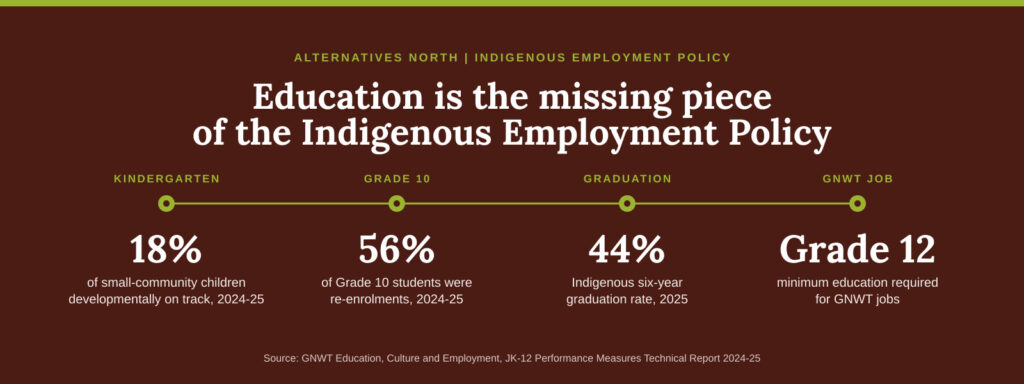
- GNWT jobs require at least a Grade 12 education, so the policy depends on a strong early childhood and Pre-K to Grade 12 system in the communities outside Yellowknife, where most Dene, Métis and Inuvialuit people live.
- The Minister responsible said the GNWT “cannot wait” for education to improve. We agreed the Minister was on the right track, but only if hiring is paired with a real strategy to improve education outcomes.
- Reliable school statistics are hard to get. Graduation, absenteeism and dropout figures are unclear, figures from the Department and from regional school boards differ, and the Auditor General found misreported graduation numbers in 2018.
- We said the new six-year graduation rate, applied mainly to Indigenous students, looks like an effort to inflate success measures rather than address student achievement.
What we asked for
A 30-year baseline of education outcomes, made public, so Northerners can discuss the way forward with the GNWT. We named nine indicators:
- Graduation rates, certificate and diploma
- Attendance rates
- Indigenous students attending university
- Indigenous journeyperson certifications
- Indigenous participation in adult education
- Indigenous students in academic upgrading, inside and outside the NWT
- Literacy levels among Indigenous populations
- Dropout rates
- Number of Northern Indigenous teachers
We also urged the Committee to prioritize training cohorts of Dene, Métis and Inuvialuit teachers and classroom assistants, and to explore partnerships with Southern universities that specialize in Indigenous education. See our submission here.
What the Committee said
We followed up in May 2025 to ask whether the Committee had collected any of this data before the policy took effect. Julian Morse, MLA for Frame Lake, replied with the Committee’s answer:
- The March 11, 2025 public briefing with the Minister of Finance raised broad concerns, but did not go into the depth of data collection we requested.
- The Committee is monitoring implementation and can raise these questions with the Minister of Finance in future meetings.
- Education outcomes sit most naturally with the Standing Committee on Social Development. Written submissions can be sent to Committees@ntassembly.ca.
- The Department of Education, Culture and Employment had just released its JK-12 Annual Report, which contains some of the data we asked for, with figures back to 2018.
What the latest data shows
The 2024-25 JK-12 Annual Report answers part of our request. The numbers below come directly from it.
44%
Six-year graduation rate for Indigenous students, 2025. For non-Indigenous students it is 78%.
40%
Six-year graduation rate in small communities, 2025. Yellowknife is at 62% and regional centres at 64%.
54%
Six-year graduation rate for the NWT overall, 2025, down from 59% in 2024.
60%
Average school attendance in small communities, 2024-25. Yellowknife is at 84%.
18%
Of Kindergarten children in small communities were developmentally on track in 2024-25 (EDI). The NWT figure is 32%.
56%
Of students enrolled in Grade 10 in 2024-25 were re-enrolments rather than first-time Grade 10 students.
Three things to read carefully
- The six-year graduation rate counts students who graduate within six years of starting Grade 10. The Department says the gap between Indigenous and non-Indigenous rates has stayed around 30 to 40 percentage points. Between 2016 and 2025 the NWT rate ranged from 54% to 62%.
- Because the NWT’s student population is small, the Department groups Early Development Instrument results into three-year clusters. The single-year small-community figure of 18% is based on 21 children.
- The NWT average attendance rate was 73.1% in 2024-25, meaning students missed more than one day of school a week on average. Attendance has declined since 2018-19 but stabilized between 2023-24 and 2024-25. Results for 2019-20 to 2022-23 are not comparable because of COVID-19 and other disruptions.
Where this goes next
The Government Operations Committee has said it is monitoring implementation of the policy and can raise our questions with the Minister of Finance in future meetings. It has also pointed to the Standing Committee on Social Development as the committee whose mandate aligns with improving education outcomes.
Our request stands: establish a 30-year baseline of education outcomes, make the data public, and let all Northerners take part in the discussion on the way forward.
Sources: Alternatives North submission to the Standing Committee on Government Operations (February 9, 2025); correspondence with MLA Julian Morse (2025); GNWT Education, Culture and Employment: JK-12 Education System Performance Measures Technical Report 2024-25.