Alternatives North thanks the Standing Committee on Economic Development and Environment for the invitation to submit on renewable heating opportunities in small communities of the Northwest Territories.
Alternatives North has been an active participant in the development, implementation, review and improvement of territorial and City of Yellowknife legislation, climate and energy plans. We have worked with local, territorial and extra-territorial partnerships to contribute positively and meaningfully to these efforts. Our submission is based on this experience and on discussions about renewable heating options.
Renewable heating options vary by community according to geography, road access, and local resources. All need to be assessed for cost and greenhouse gas emissions relative to today’s use of primarily heating oil. If a key element of the Committee’s interest is the reduction of GHG emissions, Renewable Diesel is a drop-in replacement for current heating oil and can provide a 50% or greater reduction in emissions.
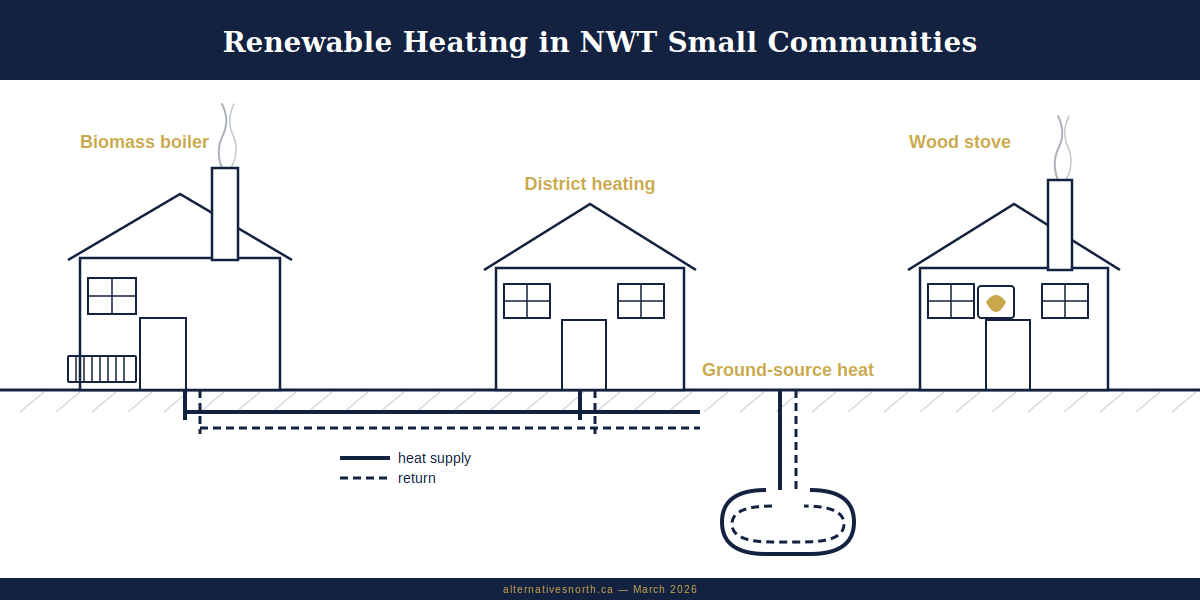
Wood can be a primary fuel source. Wood pellets have become a common source, and cordwood is a long-standing traditional source. Wood-burning devices that have the flexibility to burn either of those, or wood chips, are likely to become more common — offering the added benefit of burning local scrap wood. Wood burning is a viable option for all forested communities and those connected by road and sealift.
Geothermal resources have not been tapped in the NWT, but potential exists in the Dehcho and South Slave. Deep ground-source heat is becoming a potential source everywhere through directional drilling and closed-loop pipes that are kilometres in length.
Heat pumps using air-to-air exchange have limited applicability so far, despite their high efficiency, due to the high cost of electricity in our communities. Research is needed in southern parts of the Territories to determine feasibility there.
Whatever source is developed, highly efficient insulation of homes can help reduce costs — and that technology is well known and effective.
Fundamental to success is establishing regional standards and protocols that assist communities in achieving effective and efficient renewable energy heating. Leadership is key. For the most effective systems, community or regional public heating utilities can provide the standardization and leadership necessary. Territorial, municipal and Indigenous governments must be engaged, with GNWT playing at least a facilitating role. The simplest option — albeit less efficient — remains high-efficiency wood stoves, with a government role in culturally appropriate training and in ensuring the reliable provision of quality wood fuel.
- ►Local expertise and capacity
- ►Upfront costs
- ►The unfulfilled requirement for leadership towards coordinated neighbourhood or community-scale solutions
- ►Lack of experience, and sometimes technology, in contrast to European communities where renewable heating technology and implementation are a matter of course
- ►Community planning and layout
- ►Experience with the operation and maintenance of highly efficient wood stoves, which varies significantly from traditional wood burning
- ►Lack of training and maintenance to ensure that large municipal systems remain operational — the demand of such systems is key in scaling up biomass supply to where it becomes more economic for residential customers, while also increasing local expertise and capacity
- ►Lack of successful local examples
- ►Need for research and pilot projects on geothermal potential, and on the feasibility of ground-source heat and heat pumps in communities south of Great Slave Lake
- ►Labour and expertise in the construction, operation (biomass delivery, billing and administration), and maintenance of renewable energy systems — including monitoring and repair of distribution lines, heat exchangers, and heat generation sites. Training will be required for all activities.
- ►In most small communities the market is too small for private enterprise alone. Ownership and operation should be sponsored by Indigenous or territorial governments, which maximize local employment and training.
- ►With the adoption of wood burning, there may be opportunities for operating a wood yard where local forests are tapped, wood is aged and made available for purchase. Such an enterprise could also collect local scrap wood (from refuse sites, construction, resupply containers) — a significant source of BTUs. Wood could be provided as cordwood or chipped according to demand.
- ►For communities with markets of sufficient size, import, sale and distribution of wood pellets could be a feasible business opportunity.
- ►To our knowledge, most efforts have been ad hoc and unique to certain communities and regions. High-efficiency wood stove programs have seen reasonably good uptake, but these stoves require dry, quality wood — and because traditional practices often use relatively green wood, supply and operational issues remain.
- ►Territorial infrastructure often relies on wood pellets for primary heating, establishing a baseline volume of biomass supply that can make additional supply — such as for residences — more economic. We are not aware of GNWT activities that assist community residents to take full advantage of this opportunity.
- ►There are approximately a dozen municipal wood pellet boilers installed in smaller communities over the past decade. According to the Arctic Energy Alliance, not one is currently functional due to lack of consistent operational expertise. These have the potential to scale up pellet supply and make it more economic for residential customers.
- ►Geothermal sources have been investigated in Fort Liard but not yet implemented. Mapping of geothermal potential indicates the South Slave has potential that needs research and demonstration.
- ►New directional drilling technology — developed through fracking for fossil fuels — is now being used to access ground-source heat for heating and in some cases electricity generation. This is being tested in a Yukon community and may be applicable in parts of the NWT. See: Eavor Loop Demonstration Project
- ►GNWT needs to ensure clear allocation of responsibilities for the financial and coordinated development of standardized, efficient and economic renewable energy systems — either taking this on directly or facilitating Indigenous or municipal governments in doing so. Either way, there must be clear commitment and financing from GNWT until systems are in place and operational. Because public housing makes up a significant part of demand, GNWT stands to benefit from programs that increase local employment and reduce operational costs.
- ►Training for system administration, operation and maintenance at both the community and resident scale is essential, and responsibility for this must be clearly identified and funded.
- ►The most efficient systems are district energy systems. Scandinavian communities provide excellent examples, and their expertise should be incorporated into any systematic approach to providing our communities with efficient renewable heating. Communities should have the opportunity to become familiar with these systems.
- ►The option of high-efficiency wood stoves — and the operational requirements that go with them — should be well understood by communities as an alternative.
- ►Once residents understand the options available, the overseeing government — whether territorial, Indigenous or municipal — should help communities decide which options to pursue, then follow established protocols and standards that maximize local labour and supply.
- ►All options will provide job opportunities for administration, operation and maintenance of renewable energy heating systems. The more local the source of fuel, the more local benefits that can be realized.
- ►For wood systems, ongoing provision, delivery and handling of fuel will be required. Geothermal and other developments will also provide opportunities in construction.