A new feasibility study says a utility-scale solar plant in the Northwest Territories could pay for itself in four to five years and cut diesel use during drought years. Alternatives North agrees the idea has real promise, but our review found the numbers understate solar’s case and overstate its climate downside.
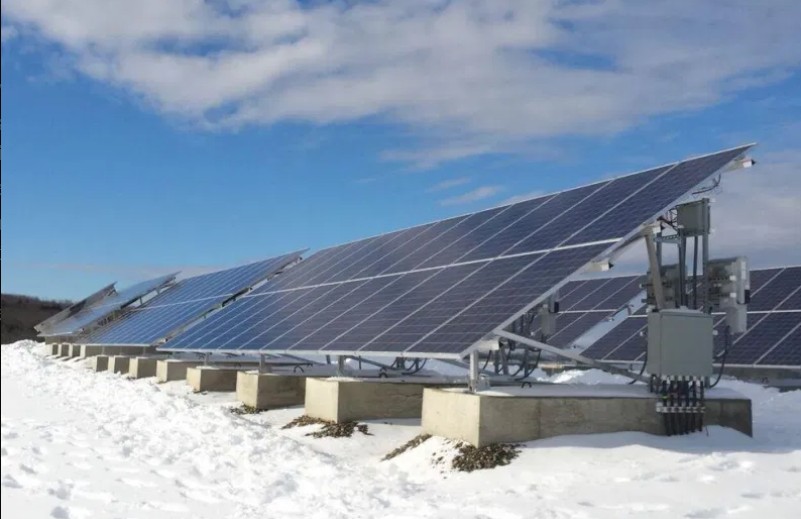
Photo credit: arka360.com
What the study looked at
Northern Energy Innovation, based at Yukon University, was commissioned by NT Energy to assess whether a 5 megawatt solar plant makes sense on one of the NWT’s two main grids. Two locations were considered: Yellowknife, on the North Slave grid that currently relies on a mix of hydro and diesel, and Pine Point, on the South Slave grid, where a new mine is expected to push demand past what hydro alone can supply.
The study also looked at whether solar equipment from the Diavik mine, which is set to close in 2029, could be reused at either site to lower construction costs.
Two different methods were used to estimate costs and energy output: RETScreen, a widely used industry modelling tool, and a “ground-up” approach built from cost data published by the US National Renewable Energy Laboratory and twenty years of NASA solar irradiance data. The two methods landed on similar conclusions but different numbers, which is worth keeping in mind anywhere you see a range below.
A genuinely interesting idea: panels standing straight up
The most novel piece of the study is its case for mounting bifacial solar panels (panels that collect light on both sides) vertically, facing east and west, rather than tilting them south in the conventional way.
In a place with heavy snow cover, a vertical panel does two things a tilted panel doesn’t. Snow reflects a large share of sunlight back upward, so a panel angled to catch that reflected light from both sides can gain considerably more energy than a standard single-sided, tilted design. And because the panel stands at a steep angle, snow doesn’t build up on its face the way it does on a sloped panel, which cuts down on maintenance.
There’s a practical payoff too. A vertical east-west panel produces power in two peaks, one in the morning and one in the evening, rather than one big peak at midday. That happens to line up well with when the territory’s Jackfish diesel plant actually ramps up its output, which means this configuration could offset more diesel generation than a conventional layout would, even if it doesn’t always produce the single highest total of energy over a year.
Illustrative comparison, adapted from the study’s analysis of the Jackfish diesel plant’s daily demand profile against vertical bifacial solar output. Note the two solar peaks, morning and afternoon, with a dip at solar noon, roughly bracketing the diesel plant’s own daily ramp-up.
The headline numbers
| Metric | Estimate |
| Initial cost, 5 MW plant | $11M to $13.7M, depending on method |
| Break-even time | About 4 to 5 years |
| Diavik mine panels reused | Could supply roughly two-thirds of a new 5 MW plant’s capacity, saving an estimated $0.4M to $2M over the plant’s life (not counting the cost of moving the equipment, which hasn’t been priced out yet) |
Where Alternatives North disagrees
We reviewed the study and wrote to NT Energy with several concerns. Two stand out.
The electricity price used doesn’t reflect what solar actually displaces. The study values every kilowatt-hour of solar power at the residential electricity rate. But that isn’t what solar power is actually worth to the grid. During drought years, solar mainly displaces diesel generation, and the true saved cost of diesel is considerably higher than the residential rate. In non-drought years, solar may just be displacing cheaper hydro power, or being sold at a commercial rate that’s lower than residential. The study doesn’t distinguish between these cases, which means its revenue estimates, and therefore its economic conclusions, are built on the wrong benchmark.
Solar and diesel aren’t measured on the same terms for climate emissions. The study counts diesel’s greenhouse gas emissions only at the point of combustion. Solar, by contrast, is charged for its full lifecycle: extracting raw materials, manufacturing, installation, operation, and eventual disposal. Diesel has upstream emissions too, from extraction and transport, and those recur every single year diesel is burned, unlike most of solar’s one-time costs. Leaving diesel’s upstream emissions out of the picture makes solar’s climate case look weaker than it actually is, which matters if this study is used to support funding applications down the road.
“GHG emission estimates for diesel fuel only included those for combustion, yet emission costs for solar included the upstream processes of material extraction, installation, operation and maintenance plus downstream processes of decommissioning and disposal. All of these elements would apply to diesel fuel annually, as opposed to one-time costs for solar.”— Andrew Robinson, Alternatives North
We also felt the study spent a lot of effort comparing small differences between panel angles while giving comparatively little attention to a bigger question: how would solar actually integrate with the NWT Power Corporation’s existing strategies for running its diesel and hydro generators during low-water years versus normal years? That’s the piece that determines whether the diesel-offset numbers hold up in practice.
Where this leaves things
Alternatives North sees real value in what this study surfaced, particularly the case for vertical bifacial panels and the potential to reuse Diavik’s equipment. But we don’t think the report’s economic conclusions should be taken at face value until the electricity pricing and emissions accounting are corrected. We’ve asked NT Energy to discuss next steps and will share updates here as they come.
Read the source documents
- Feasibility Study for NT Energy Solar Potential (Phase 2, Final Draft) — Northern Energy Innovation, Yukon University
- Alternatives North’s feedback letter on the prefeasibility study
Prepared by Alternatives North — alternativesnorth.ca