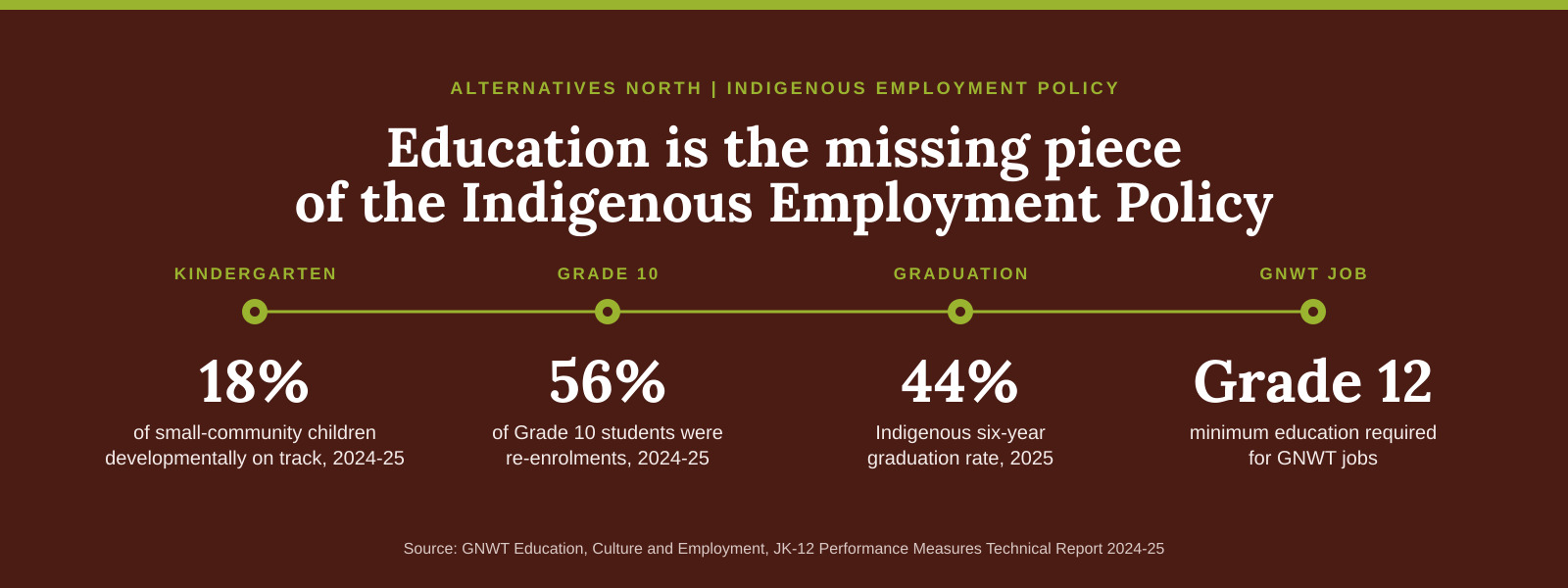
In February 2025, Alternatives North asked the GNWT to establish a baseline of education outcomes, warning that the Indigenous Employment Policy cannot succeed without better results in community schools. The Department of Education, Culture and Employment’s latest report, released in July 2026, shows what that warning was about. This is an update to our original post.
What we asked for
In our February 2025 submission to the Standing Committee on Government Operations, we recommended a 30-year baseline of education outcomes, made public, covering nine indicators. Our reasoning was simple: most GNWT jobs require at least a Grade 12 education, so the policy depends on the school system that feeds it, especially in the communities outside Yellowknife where most Dene, Métis and Inuvialuit people live.
What the latest results show
The 2024-25 JK-12 Annual Report does not measure how the policy is performing. It measures the school system the policy depends on. The numbers confirm the gaps we described.
44%
Six-year graduation rate for Indigenous students, 2025. For non-Indigenous students it is 78%.
40%
Six-year graduation rate in small communities, 2025. Yellowknife is at 62% and regional centres at 64%.
60%
Average school attendance in small communities, 2024-25. Yellowknife is at 84%.
54%
Six-year graduation rate for the NWT overall, 2025, down from 59% in 2024.
18%
Of Kindergarten children in small communities were developmentally on track in 2024-25 (EDI). The NWT figure is 32%.
56%
Of students enrolled in Grade 10 in 2024-25 were re-enrolments rather than first-time Grade 10 students.
What the report still does not show
Of the nine indicators we asked for, the 2024-25 report fully covers one, partly covers three, and does not cover five. Its data reach back about a decade, not 30 years.
| Indicator we asked for | In the report? | What the report has |
|---|---|---|
| Graduation rates, certificate and diploma level | Partly | One six-year graduation rate, by Indigenous status and community type. No certificate versus diploma split. |
| Attendance rates | Yes | By community type, grade and year. Not split by Indigenous status. |
| Indigenous students attending university | Partly | Share of graduates pursuing post-secondary within three years, by community type. Not split by Indigenous status, and not university only. |
| Indigenous journeyperson certifications | No | Not reported. |
| Indigenous participation in adult education | No | Adult students are excluded from the report’s enrolment counts. |
| Indigenous students in academic upgrading | Partly | Share of graduates returning to NWT high school within three years. NWT only, with no Indigenous split. |
| Literacy levels among Indigenous populations | No | Diploma exam results are reported, but not literacy levels. |
| Dropout rates | No | The closest measure is Grade 10 re-enrolment. |
| Number of Northern Indigenous teachers | No | Educators are counted as one group, with no Indigenous breakdown. |
Why this matters for the policy
Most GNWT jobs require at least a Grade 12 education. When 44% of Indigenous students and 40% of students in small communities graduate within six years, that sets a ceiling on how many can qualify, however well the policy is designed. That is the link we asked the GNWT to measure and make public.
What we are asking for
Alternatives North calls on the GNWT to establish a 30-year baseline of education outcomes covering all nine indicators, to publish it so that all Northerners can take part in the discussion on the way forward, and to make producing cohorts of Dene, Métis and Inuvialuit teachers and classroom assistants a priority.
Read the original post for the full case.
Sources: GNWT Education, Culture and Employment, JK-12 Education System Performance Measures Technical Report 2024-25 (July 2026); Alternatives North submission to the Standing Committee on Government Operations (February 9, 2025).